Monday, June 9, 2014

Anticipation: the good tension

As the in-world time folds toward a significant event in a story I'm writing, I want the reader to anticipate the sharp moment of the event. Like a hand fan closing, the story needs to move toward that snap. In a larger sense, the story is moving toward a climax, but readers won't be able predict the climax so early on, if I'm doing my job right.

It's the end of Act I. Our Heroine will experience a change in her understanding that sets her up for Act II.

I find myself thinking about how fun it is to enjoy a story where you feel carried along on a clear path, but you are enjoying the ride enough not to look ahead and speculate -- at least, not overmuch. It can be disappointing to guess the ending. It's even more disappointing when the ending is a mismatch for the ending that seemed to be coming.

Anticipation is a good tool for managing audience expectation. It has the benefit of creating a fun kind of tension, like knowing of an upcoming vacation. A few years ago, a study by researchers in the Netherlands showed that the anticipation of a vacation increased people's happiness greater than the vacation itself. Readers have two kinds of anticipation. They can look forward to the opportunity to read the book (because who gets the time or has the stamina to read something straight through, beginning to end?), and they can carry hopes for what will happen in the story.

Pacing in a written work is different from the pacing of a movie or television show, where the pacing is part of the real time it takes to show the story visually. In written work, the reader participates in pacing by reading speed and time to read, which affects the pacing in the narrative structure. The writer can't control when the reader has to stop; the writer can only make it hard for the reader to put the story down.

If the story is a retelling, part of a series, a licensed world, or a fanfiction, then the raw elements "package" includes items that the reader wants and expects. A good story of this type uses familiarity to carry the reader along. For example, Sherlock Holmes fans wonder how the latest incarnation of Holmes will address the role of Doctor John Watson; the nemesis, Professor Moriarty; the one woman who outsmarted Holmes, Irene Adler; and the "death" of Holmes at Reichenbach Falls. Whether or not Holmes's use of "the seven percent solution," his disguises, or the Baker Street Irregulars are included seem to be lesser elements that may or may not be utilized. Sure, the story has to have original elements to keep it from being a boring rehash of the original work, but if the new story doesn't have familiar characters, story points, and/or world elements addressed in some way, the reader is going to feel anxious when they don't appear and will feel cheated by the end.

An original work gets to create that waiting-for-the-last-day-of-senior-year feeling more freely, but all stories still have a toolbox from which to draw. The template of the genre provides some. The story may draw on tropes with a wink at the savvy reader. In my opinion, a good story uses multiple elements to create that good tension, and the most important one is that it develops the secondary characters as fully as the main character, through the series of interactions that happen throughout the story. Good characters carry a story. This sounds like writing 101, and it is, and here's why: looking forward to a vacation get-away is happiness-increasing anticipation, but looking forward to a vacation with someone you love to be with is twice as good. If your readers want to spend time with your characters, they will look forward to the next opportunity, whether that's the next chapter or the next book.

Sunday, May 11, 2014

Scraps


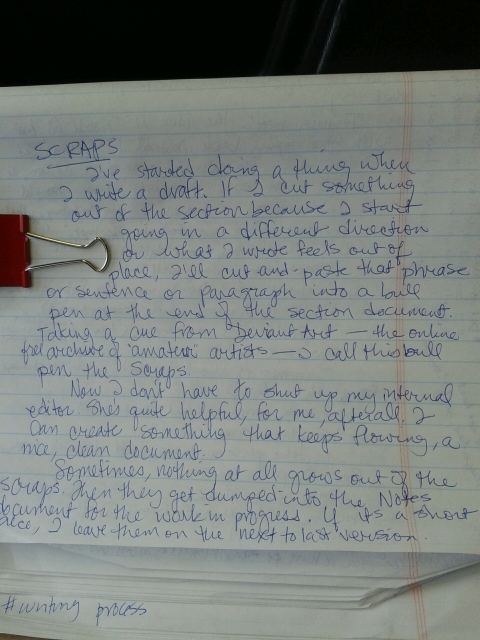
I've started doing a thing when I write a draft. If I cut something out of the section because I start going in a different direction or what I wrote feels out of place, I'll cut-and-paste that phrase or sentence or paragraph into a bull pen at the end of the section document. Taking a cue from Deviant Art -- the online free archive of "amateur" artists -- I call this bull pen the Scraps.

Now I don't have to shut up my internal editor. She's quite helpful, for me, after all. I can create something that keeps flowing, a nice, clean document.

Sometimes, nothing at all grows out of the Scraps. Then they get dumped into the Notes document for the work in progress. If it's a short piece, I leave them on the next-to-last-version.


Saturday, April 5, 2014

Sketching on Napkins


Written on the back of an envelope from a received payment. The postmark, printed on the back side, almost looks like a stamped chop.
If I were to sum up my father’s character in one image, it would be of him at the table of a restaurant, discussing an idea, in conversation, sketching on a paper napkin to illustrate a design. He would be using his Monte Blanc fountain pen. Incidentally, this is the same image that I would use to describe creativity.
Creativity isn’t the bold use of colors and shapes. It’s not using all the crayons in the box to color a picture. Creative force flows like fountain pen ink onto a white paper napkin. It doesn’t wait for conditions to be perfect: perfect materials, perfect venue, or even perfect audience. (As often as not, we kids were my dad’s audience over brunch.) It’s inspiration landing on any surface. It’s the active mind moving the active hand. It’s about creativity being part of who you are, not a hobby.

Tuesday, February 18, 2014

Out now on Smashwords!


Fae Love contains my faerie love story, "The Reward of It All." 

The first published story featuring Jouet the faerie and her mortal beloved, Xiaowen, "The Reward of It All" takes its title from Robert Browning's evocative poem about death, "Prospice." It was difficult to write a happy-for-now short story for Jouet. I spent the whole time writing it wondering how I could hide the Doom hanging over her future. 

Where any character's story begins and ends is a slippery thing. Jouet walks a hard road from who she is in this story to her eventual redemption and happy ending. She was first conceived in my mind as a villain, and in other stories she plays an antagonistic or tragic role. For "The Reward of It All," I wanted to capture that short time when she is truly happy.

The fantasy adventure novel that begins Jouet's story is still in the early stages of editing and revising, but it exists!

Tuesday, November 5, 2013

Alphabet Soup


I am a creative speller. That is, I’m awful at spelling words correctly. My misspellings aren’t the common ones that get the dander up all over the internet, such as the “There, it’s your homophone” problem. There/they’re/their, it’s/its, and your/you’re (but not yore, for some reason) are the subject of many a rant. But not from me. I live in a glass house. If there was a believable way for me to misspell glass or house, I might have already done it.


No, my misspellings range in time and type from “rot iron” when I was in the fourth grade (and I am forever grateful to have learned the correction, “wrought iron”) to a recent misplacement of gate (portal) for gait (stride) and gaff (sound equipment) for gaffe (blunder). I also wildly mispronounce words. I was in eighth grade before I discovered that “deny” was not pronounced “denai” not “denny,” which meant that there wasn’t an archaic “denny” for the meaning refusal, and it was, in fact, the same “denai” sounding modern word that meant… refusal.


The cause is the same for both: me. I live in my own head a lot. I’m not paying full attention, usually. I have a significantly large frequent-usage vocabulary, and I enjoy reading classic and literary works. I write poetry. To tell the truth, I have the same problem with math. I don’t dislike math, but I am sloppy about it. When math doesn’t have a scribbler’s full attention, it simply does not work. Language, however, will work with letters missing and grammar broken; it will function with worn out phrases and awkwardly posed syntax.


I know that I am a reckless speller. There are so many words; I can only learn to spell them correctly a few at a time. The internet provides a readily accessible dictionary for the ones of which I am unsure. The spelling checker in my word processing program snags on the ones with extra and misplaced letters. Many others get the wrong word as stunt doubles.


That is why writing is like sculpting. It is an art of construction, like sewing clothing. It’s like making soup from scratch.


It’s the most like making soup. I adore the line in the movie Gross Pointe Blank where Marcella yells at her sister over the telephone, “it's not going to be a boring soup! It just, that's just the base! You put the chicken in, you gotta add other flavors. Carrots and celery are just a base of a soup!


It’s a favorite line because finishing is a process, whether the creator is sculpting art or making soup. The miracle of soup is that a delicious broth starts as plain, clean water. It does matter a bit how good of water that is. The soup maker might want to filter it if the plumbing gives an unpleasant metallic taste to the tap water. Nevertheless, what makes the soup fabulous is how much else goes into it. With soup, you don’t just dump it all into a pot, heat it to boiling, and call it done.


Take, for example, chicken soup. That’s the soup for the season, right? There are as many ways to make chicken soup as there are grandmothers to pass along the family recipe. In rough terms, they are all made in layers. The soup needs time to simmer, and a great soup has a garnish, such as freshly minced parsley, that finishes the fullness of its flavor. A soup can be simple or complex, consommé (not “consume”) or chowder, hot or chilled. Most recipes start with a base, let us (not “lettuce”) say onion, celery, and carrots sautéed in butter. Add fresh garlic. Add a bit of tomato paste. Add vegetable stock…


Writing is the same. I’ll cover my counters with the ingredients of my story (the first draft), busily simmering stock in one pot while chopping and measuring and putting the components into little bowls. The stock might be considered equivalent to my theme. It’s something I use often, something that has simmered and cooled with its flavor agents to give it body. The theme will give the story fullness, as stock give fullness to a soup.


At first, it’s all there, but it’s something of a mess. The parts that don’t improve the soup will be cut away. If they are nice parts, such as the stems of broccoli when I just need florets, I’ll save them for use in something else. The timing of when to add the ingredients matters. Garlic can’t go in too soon before the stock, or it will burn and wreck the flavor. If forgotten earlier, tomato paste can be added as late as a minute before serving. Salt should be added near the end, when the flavors have come together, and the soup maker can taste the soup to know how much to add. When I edit a first draft, I often move sentences or whole sections around for improved clarity and flow. I read the story aloud to help with the editing (tasting the soup for salt), which allows me to hear the actual sound of the prose.


One of the best things about soup is how it improves with sitting overnight. I have found that if I leave a story alone for a while after I think it is done, when I come back to it, I can better see the parts that I like as they are as well as the places to polish. Maybe I’ll add some lemon juice, which works so well in my minestrone with collard greens. Maybe I’ll finished the red curry shrimp soup with coconut milk to tame the heat and some fresh cilantro for umami. The potato cheddar soup is always best thinned with milk to help it warm and served with an addition of more cheese, a blast of freshly ground black pepper, and some toasted bread.


The difference between soup and story is that once the soup is eaten, it’s gone. Also, that there is a limit to how much honing can be done to a soup. Stories are great, that way. There’s a limit to how much can be done to improve a sculpture or a suit of clothes, too. A story can always get better. It can grow, contract, or split. It can be set aside, picked up again, and reborn. A story wants to be made better. It wants to be the best that it can be.


So, I love fixing my mistakes, because corrections are part of completion. The story isn’t finished at the first draft. Every draft is a layer to add nuance and shape, color and texture, and flavor.

It’s not going to be a boring soup.

Tuesday, August 27, 2013

Fruit-O-Matic

When you think “vending machine,” the image that comes to your mind is most likely a six foot tall, refrigerated monster with an illuminated panel. An illuminated plastic panel, enticing you with larger than life images to purchase chilled beverages, may be the brightest light in a dark hallway. You’ll have the impulse to check your wallet for a crisp dollar, but maybe it’s a model that takes swiped credit cards.

Now think of something completely different, from a completely different time. I don’t mean the revolving, plexiglass columns filled with questionable sandwiches, pints of 2% milk, or the perplexing packaged, hard boiled egg. I don’t mean the often astonishing Japanese vending machines that offer heated canned coffee or items you would not expect from a vending machine. I don’t even mean those wall mounted, never stocked boxes in the women’s lavatory of old government buildings.

I want you to think about the Fruit-O-Matic.

The Fruit-O-Matic! More steampunk apple dispensing machines existed before the manufacture of the short, utilitarian model that stood apart in the courtyard of my high school, and slicker machines exist now, but the Fruit-O-Matic did what it said on the box, no more, no less. Drop a quarter in and get your choice of an apple -- usually a green Granny Smith -- or an orange. The fruit was always fresh, always good.

Someone tended that old box. Was it the cafeteria staff? Was an outside vendor allowed on school campus? I never knew. For all I know, that fruit vending machine was magic. It had a philosophical poetry (apple vs. orange) and an incongruous humor (no candy bars, only sweet fruit). Positioned far from both the snack window and the cafeteria, against a wall and away from routes of traffic, it was an overlooked wallflower at the school dance of everyday.

It was the only place on or close to campus to get something to eat after school hours in the short time between my last class and my drama rehearsal. I became very fond of the Fruit-O-Matic and the stroll across the quadrangle. Usually, I chose an apple, crunching into it as I returned to the Little Theater.

Sometimes, the best memories are the little ones.

. . .

A weekly delivery of fruit comes to my workplace. Apples, bananas, pears that no one seems to want, grapes, and pluots -- depending on the time of year. Rarely do we get citrus, though last winter it was satsuma mandarins for weeks, until they languished as badly as the pears. Because this not the region for oranges, it seems that my fruit choice has become both more automatic and already made for me.